


Custom Probe Service
Gxene Biotech has been dedicated to molecular biology and cytogenetics research for many years. With rich experience and years of knowledge accumulation, our scientists can provide one-on-one customized solutions according to the specific project needs of customers, develop various types of fluorescence in situ hybridization (FISH) probes, and from solution customization, probe design and synthesis, hybridization detection to final data analysis, we have standardized procedures, a comprehensive technical service system, and a team of senior and rigorous scientific experts, ensuring the provision of high-quality, customizable FISH services to support customers' project research.
FISH is a non-radioactive technology combining molecular biology and cytogenetics. This technology uses the specific binding of fluorescent probes to target sequences on chromosomes to visualize specific chromosomal locations, rapidly, accurately, and efficiently helping us conduct research and analysis at the gene level. It is widely used in gene expression analysis, detection of chromosomal structural and numerical abnormalities, rapid clinical diagnosis and prognostic markers of cancer, human prenatal diagnosis, and other fields, and has very important application value. The customized FISH probe service solutions provided by Gxene Biotech are not limited to single-gene or single-region analysis. We provide custom-labeled FISH probe services for a range of molecular biology and cytogenetics project research.


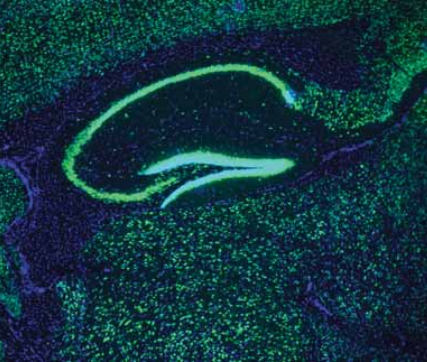
Figure: LNA oligonucleotide probe detecting mi-R-124 in the adult mouse brain
Custom Services Provided by Gxene Biotech:
FISH Probe Types Provided by Gxene Biotech:
|
Probe Type |
Advantages |
|
Double-stranded DNA probe |
Most widely used at present, simple and easy to perform; once successfully cloned, a large number of labeled probes can be obtained using the same amplification and labeling procedures |
|
Single-stranded DNA (ssDNA) probe |
Stable, easier to use, more specific, resistant to RNase, better tissue penetration, no self-hybridization |
|
RNA probe (ribosomal probe) |
Higher thermal stability, better tissue penetration, higher specificity, less affected by RNase |
|
Synthetic oligonucleotide |
Economical, stable, ready to use, strong specificity, resistant to RNase, good tissue penetration, good reproducibility |
According to the customer's project needs, we provide one-on-one consultation with technical experts (for details, please consult our technical experts or fill out the information registration form, and our technical staff will contact you).
Fluorescein Labeling Methods for Probes:
(1) Indirect labeling method: labeling is performed by nick translation using biotin-labeled dUTP;
(2) Direct labeling method: fluorescein is directly covalently bound to the probe nucleotide or pentose phosphate backbone, or fluorescein nucleotide triphosphate is incorporated during probe labeling by nick translation.
Deliverables from Gxene Biotech:
—Customized FISH probes
—FISH probe validation results (quality control report)
Service Advantages:
—Provide personalized customized services to meet customer needs
—The team is experienced and the technology is mature; the provided probes can quickly and accurately identify specific binding sites, are stable, and can be stored for the long term
—Provide FISH probe validation to ensure that the probes bind to the expected chromosomal regions
—Provide one-stop technical services from solution customization and probe preparation to probe quality control


