

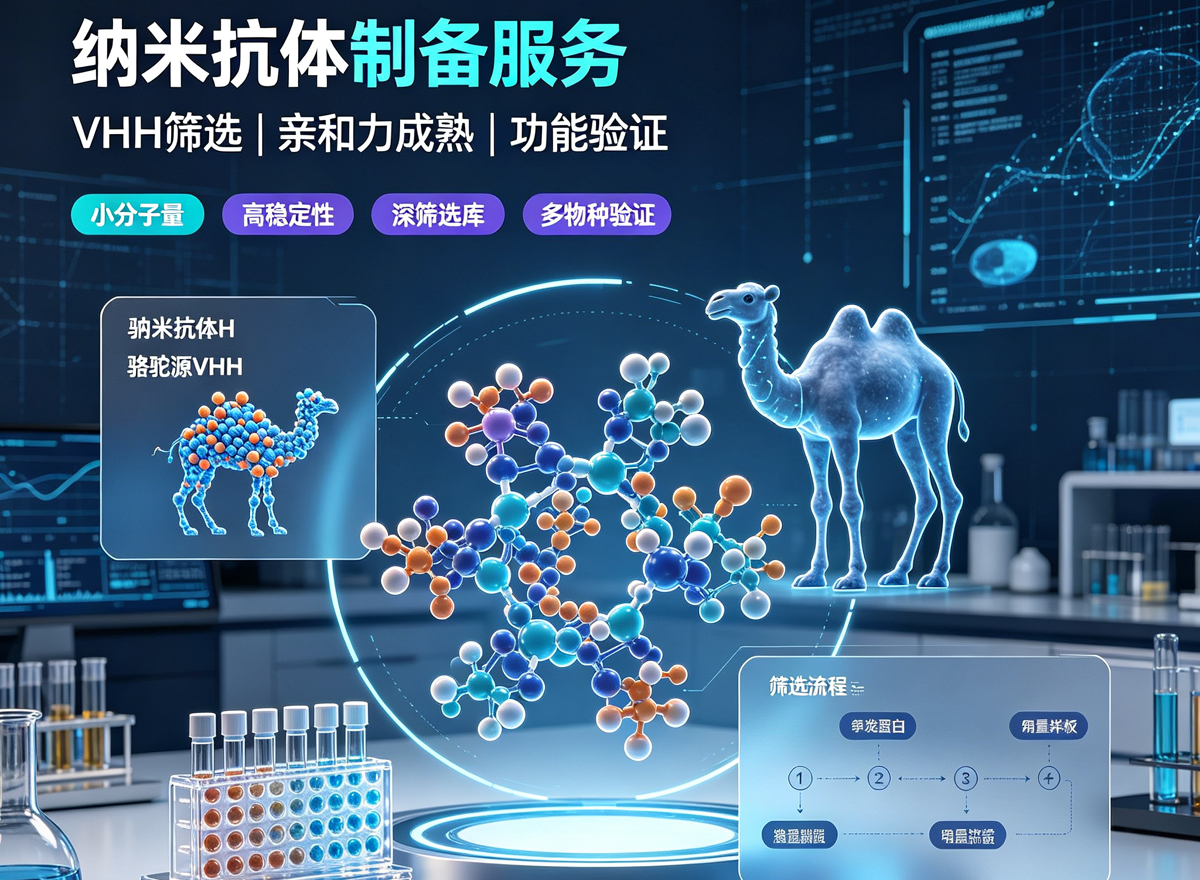

Phage display technology provides the foundation for the development of fully human therapeutic antibodies, expands the application of directed evolution technology in antibody and peptide modification and screening, and is of great significance to the development of antibody drugs. Gxene Biotech has been researching in the antibody field for many years. The phage display technology services we have established cover multiple library types and can provide customers with multi-species monoclonal antibody preparation services based on phage antibody library platform technology, including monoclonal antibodies from species such as human, mouse, rabbit, chicken, goat, goose, pig, bovine, horse, donkey, camel, alpaca, and shark. We can provide customized services according to customer needs and offer flexible and effective screening services.
In addition, Gxene Biotech has rich experience in antibody engineering construction and can provide comprehensive upstream and downstream antibody services, including antibody humanization services, human scFv antibody library construction services, human Fab antibody library construction services, human antibody phage library preparation services, custom phosphorylated antibody services, and antibody affinity maturation services, etc., meeting the scientific research requirements of different customers.
Phage Antibody Library Technology Platform:
Phage display technology (PDT) is a new technology that fuses exogenous proteins or peptides with phage coat proteins, displays them on the phage surface while maintaining a specific spatial conformation, and uses specific affinity interactions to screen for specific proteins or peptides. In 1985, Smith, G.P. proposed inserting exogenous genes into modified phage coat protein genes to express fusion proteins containing exogenous proteins or peptides. Phages carrying such fusion proteins are called fusion phages. Through the repeated process of adsorption-elution-amplification, phages containing exogenous proteins that can specifically bind to the target protein are screened from a phage library expressing various exogenous proteins, and then enriched, amplified, and subjected to gene sequence determination to infer the amino acid composition of the exogenous protein. This technology combines genotype with phenotype and molecular binding activity with the amplifiability of phages, making it a new screening technology. It has been successfully applied to antigen epitope analysis, monoclonal antibody screening, and determination of protein function antagonistic peptides or mimetic peptides, etc., and has the advantages of large screening capacity, large-scale production by fermentation, and simple methodology. It plays an important role in vaccine design and other aspects.

Figure 1 Schematic diagram of phage display technology
Phage Display System:
The M13 single-stranded filamentous phage display system is currently a widely used library display system. By fusion-expressing proteins, antibodies, or peptides with the phage pIII protein, they participate in phage assembly and are displayed on the phage surface, forming a phage display library.
Gxene Biotech uses M13 filamentous phage coat protein pIII and pVIII display technology to construct natural or immune phage antibody display libraries for different species for customers, with library capacity reaching 1011.
Service Advantages of Our Phage Antibody Display Technology Platform:
–Rapid preparation capability for soluble antigens: combined with the company's existing recombinant protein expression system, high-purity, highly biologically active soluble antigen proteins can be prepared in a short time to support the immunization and screening of phage antibodies
–Mature and stable immune library construction technology: the primary immune phage library we currently obtain can reach a library capacity of 108-109, with sequence abundance >99%, ensuring that antibodies obtained by direct screening reach affinity at the nM or even pM level
–Fast and reliable candidate antibody screening and preliminary identification technology: according to different functional requirements of antibody drugs, multiple screening systems have been developed, including direct screening, competitive screening, negative screening, cell-based screening, etc.


