

Recombinant Mouse PHF8 Protein
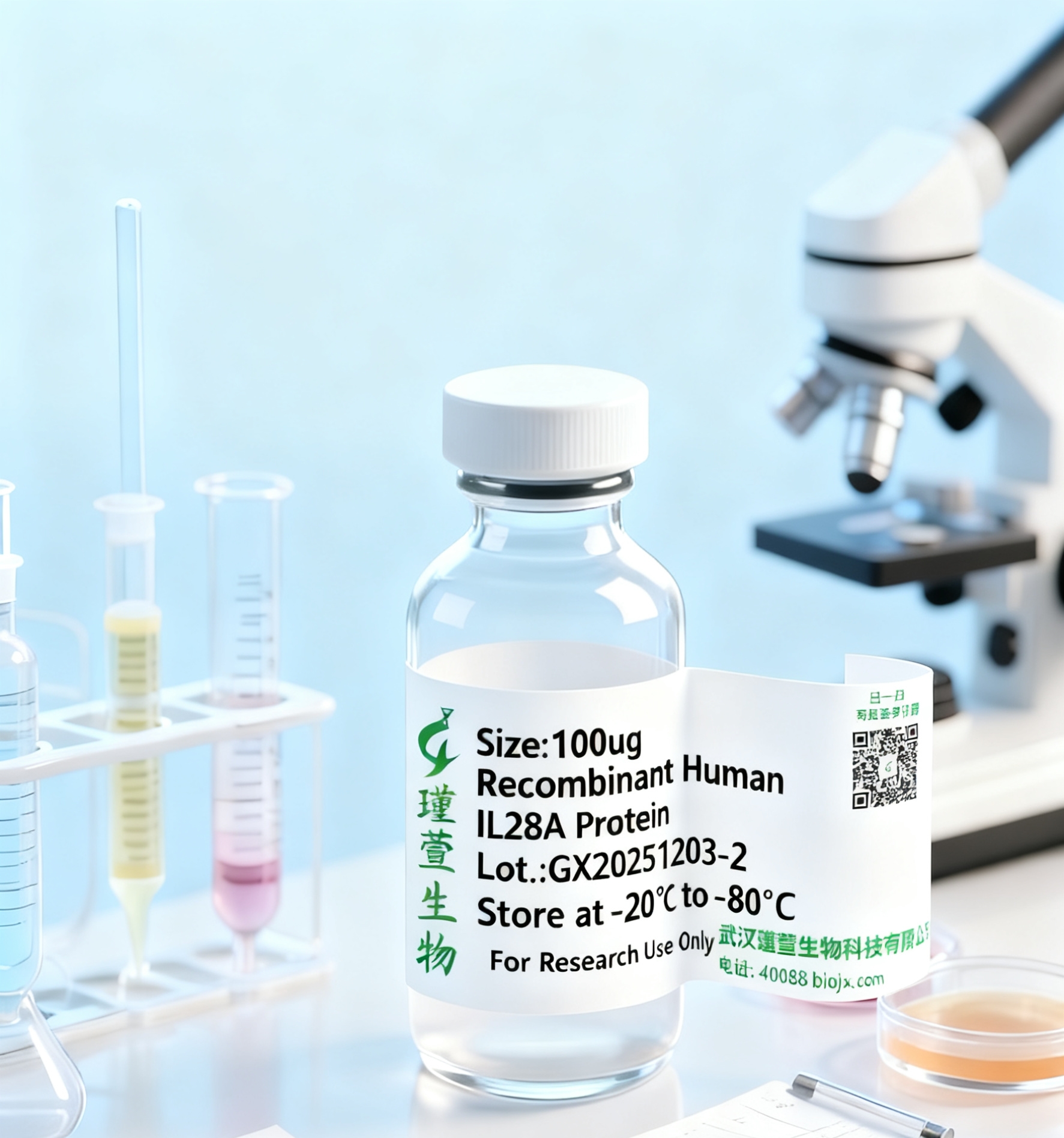
| 货号: | GXP54695 |
|---|---|
| Swiss Prot: | Q80TJ7 |
| 种属: | Mouse |
| 表达宿主: | E. Coli / 293F |
| 表达区间: | 1–1023aa |
| 标签: | Customize |
| 纯度: | >90% |
| 内毒素: | < 1.0 EU/μg / < 0.1 EU/μg |
价格:¥2580
货期:3-4周/weeks
规格:
说明书:
产品详情
| 产品名称: | Recombinant Mouse PHF8 Protein |
|---|---|
| 别名: | Phf8 Kiaa1111 |
| 货号: | GXP54695 |
| Swiss Prot: | Q80TJ7 |
| 种属: | Mouse |
| 表达宿主: | E. Coli / 293F |
| 表达区间: | 1–1023aa |
| 标签: | Customize |
| 纯度: | >90% |
| 实际分子量: | Depends On Tags |
| 内毒素: | < 1.0 EU/μg / < 0.1 EU/μg |
| 无载体: | Yes |
| 无动物源: | Yes |
| 制剂: | Lyophilized from a 0.22 μm filtered solution of PBS, pH 7.4.Contact us for customized product form or formulation. |
| 描述: | Histone lysine demethylase with selectivity for the di- and monomethyl states that plays a key role cell cycle progression, rDNA transcription and brain development. Demethylates mono- and dimethylated histone H3 'Lys-9' residue (H3K9Me1 and H3K9Me2), dimethylated H3 'Lys-27' (H3K27Me2) and monomethylated histone H4 'Lys-20' residue (H4K20Me1). Acts as a transcription activator as H3K9Me1, H3K9Me2, H3K27Me2 and H4K20Me1 are epigenetic repressive marks. Involved in cell cycle progression by being required to control G1-S transition. Acts as a coactivator of rDNA transcription, by activating polymerase I (pol I) mediated transcription of rRNA genes. Required for brain development, probably by regulating expression of neuron-specific genes. Only has activity toward H4K20Me1 when nucleosome is used as a substrate and when not histone octamer is used as substrate. May also have weak activity toward dimethylated H3 'Lys-36' (H3K36Me2), however, the relevance of this result remains unsure in vivo. Specifically binds trimethylated 'Lys-4' of histone H3 (H3K4me3), affecting histone demethylase specificity: has weak activity toward H3K9Me2 in absence of H3K4me3, while it has high activity toward H3K9me2 when binding H3K4me3. Positively modulates transcription of histone demethylase KDM5C, acting synergistically with transcription factor ARX; synergy may be related to enrichment of histone H3K4me3 in regulatory elements. {ECO:0000250|UniProtKB:Q9UPP1}. |
| 活性测试: | Not Test |
| 复溶: |
Centrifuge the vial before opening. Reconstitute to a concentration of 0.1-0.5 mg/mL in sterile distilled water. Avoid vortex or vigorously pipetting the protein. For long term storage, it is recommended to add a carrier protein or stablizer (e.g. 0.1% BSA, 5% HSA, 10% FBS or 5% Trehalose), and aliquot the reconstituted protein solution to minimize free-thaw cycles. 收到重组蛋白产品之后请检查蛋白冻干粉末是否贴于瓶底,如果粉末浮起,开盖之前请先低温离心。将蛋白用说明书中指定的缓冲液复溶至0.1-0.5 mg/mL(请注意蛋白复溶浓度不能低于0.1 mg/mL),室温平衡5-10 min保证充分溶解,复溶过程中请不要剧烈涡旋及吹打蛋白溶液。如需长期储存,建议复溶时添加载体蛋白或者稳定剂(如0.1% BSA, 5% HSA, 10% FBS 或者 5% 海藻糖),同时将复溶后的蛋白溶液按照需求进行分装,储存于-20°C至-80°C,随取随用,避免反复冻融。 |
| 储存: |
Store at -20℃.Store the lyophilized protein at -20℃ to -80 ℃ up to 1 year from the date of receipt. After reconstitution, the protein solution is stable at -20℃ for 3 months, at 2-8℃ for up to 1 week. 未开盖的干粉蛋白在 -20°C至-80°C可保存12个月; 复溶之后,蛋白溶液在-20°C及以下可保存3个月,在2-8℃可保存1周。 |


